

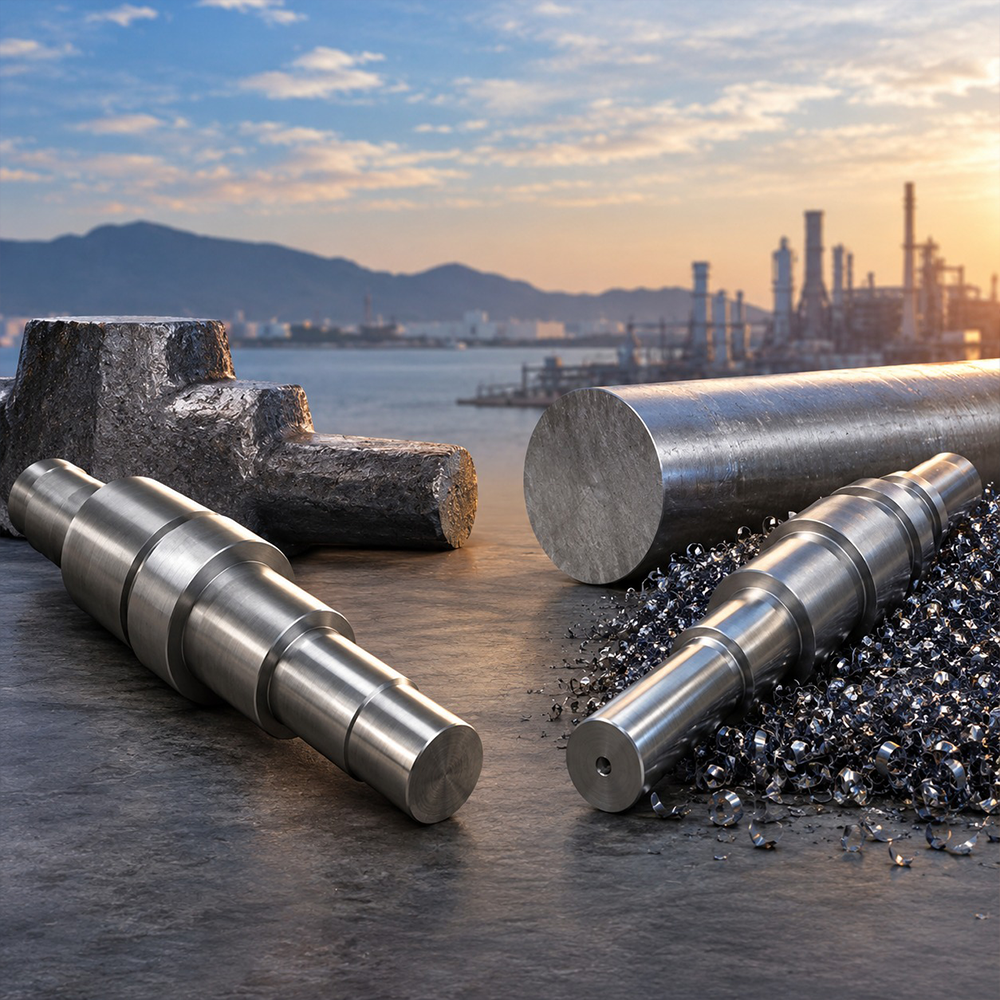
Radial Forging vs Machining from Bar: Material Utilisation, Grain Flow, Machining Time and Total Cost
When an OEM needs a long shaft or stepped component, one of the most important manufacturing decisions is whether to machine the component directly from bar stock or first create a near-net forged preform. Machining from bar appears straightforward: purchase material at the largest required diameter and remove everything that is not part of the […]

Radial Forging of Long Shafts: Straightness, Distortion Control and Manufacturing Challenges
Long shafts are among the geometries most naturally associated with radial forging, but increasing component length introduces its own manufacturing challenges. A small angular deviation that has little consequence in a short component can translate into significant displacement across several metres. For this reason, radial forging of long shafts requires coordinated control of deformation, temperature, […]
Common Radial Forging Defects: Laps, Cracks, Eccentricity, Coarse Grain and How Manufacturers Prevent Them
Radial forging can produce highly efficient shafts, bars and hollow preforms, but like every metal-forming process it requires careful control of material flow, temperature, deformation and tooling. When those variables are poorly controlled, defects can occur. For aerospace, defence, oil & gas, marine and power-generation buyers, understanding common radial forging defects and their causes is […]

NDT for Radial-Forged Shafts: Ultrasonic Testing, MPI, Liquid Penetrant Testing and Inspection Requirements
A radial-forged shaft can appear flawless externally while containing an unacceptable internal discontinuity. For critical aerospace, defence, oil & gas, marine and energy components, dimensional inspection and visual examination alone are therefore insufficient. Non-destructive testing (NDT) allows a radial forging to be evaluated for relevant internal or surface discontinuities without destroying the component. Differe

Heat Treatment After Radial Forging: 4340, 300M, Titanium and Inconel Forging Requirements
Radial forging determines component shape and creates a thermomechanical deformation history. Heat treatment then plays a major role in determining the final microstructure and mechanical properties of the material. This relationship is especially important for critical components. Two radial-forged shafts with identical dimensions can exhibit substantially different strength, hardness, toughness and fatigue behaviour if the

Radial Forging Reduction Ratio Explained: Cross-Section Reduction, Forging Penetration and Internal Material Quality
A radial forging can reach the correct external dimensions and still have an inadequate deformation history. This is why experienced forging buyers evaluate more than final diameter. One of the important concepts is forging reduction ratio, which describes the relationship between the starting cross-section and the cross-section achieved after forging. For aerospace, defence, energy and […]
Mandrel Radial Forging for Hollow Shafts and Tubes: Wall-Thickness Control, Concentricity and Material Savings
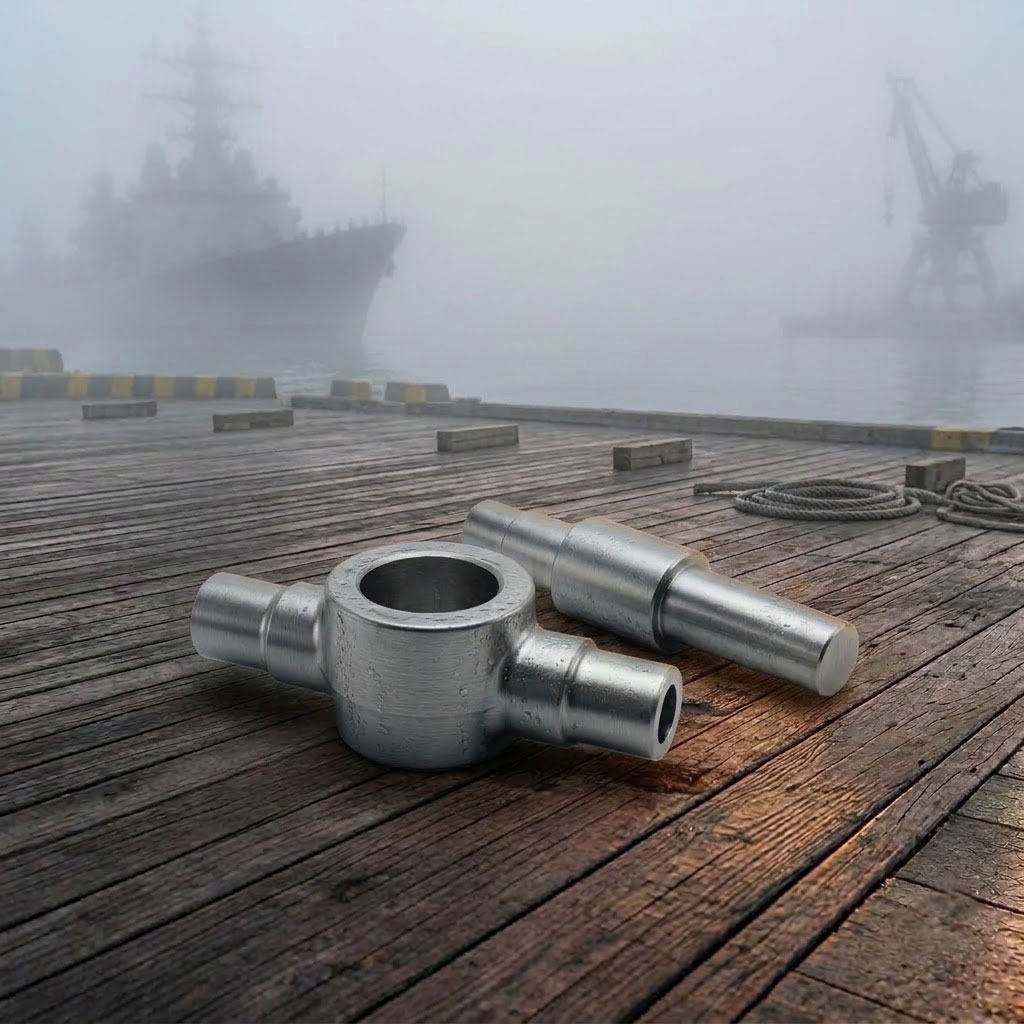
Hollow shafts and tubes present one of the strongest technical and economic applications for radial forging. If a finished component contains a large central bore, manufacturing the entire part from solid stock means purchasing a considerable amount of material that will eventually be removed during drilling, boring or trepanning. Mandrel radial forging provides an alternative […]

Hot vs Cold Radial Forging: Process Differences, Material Behaviour and Critical Component Applications
Radial forging is often discussed as though it were a single manufacturing process. In practice, the temperature at which the material is forged has a major influence on deformation force, achievable reduction, dimensional accuracy, surface condition and final mechanical properties. The two broad approaches are hot radial forging and cold radial forging. For heavy aerospace, […]

Grain Flow in Radial Forging: Why Incremental Deformation Matters for Fatigue-Critical Shafts
“Grain flow” is one of the most frequently repeated phrases in forging marketing and one of the most frequently oversimplified. A forged component does not become fatigue-proof because somebody compressed it with a hammer. The useful engineering advantage comes from controlled plastic deformation, sufficient reduction, appropriate temperature and heat treatment, producing a material structure suited […]

Radial Forging Tolerances and Surface Finish: How Near-Net Forging Can Reduce Machining
One of radial forging’s most commercially interesting characteristics is that it sits between rough heavy forging and precision finished machining. It can produce geometry substantially closer to the finished component than a simple oversized billet, yet it remains a forging process and should not be expected to replace precision machining for highly toleranced interfaces. Understanding […]

Hollow Radial Forging vs Conventional Open Die Forging: Material Savings, Weight Reduction and Process Selection
Hollow components create one of the most interesting process-selection questions in heavy manufacturing. Should a supplier forge a solid billet and remove the centre through machining? Should a hollow be produced through open-die punching and mandrel operations? Or can radial forging create a tubular preform closer to finished geometry? There is no universal answer. The […]

Radial-Forged Marine Shaft Supplier for USA from India: Propulsion, Transmission and Shipbuilding Applications
A marine propulsion shaft operates in a deceptively severe environment. It may rotate for thousands of hours, transmit enormous torque from propulsion machinery, experience bending from alignment and bearing loads, and remain exposed to seawater-related corrosion risks throughout its service life. For shipbuilders and marine equipment OEMs, the shaft is therefore not a commodity steel […]