
Forging for defence programs: why qualification takes years and capacity alone isn’t enough
Why Defence Qualification Is Designed to Be Slow
Defence procurement systems are not inefficient by accident, they are intentionally conservative.
Buyers assume:
- Components may be deployed in mission-critical environments
- Failure can lead to loss of life or strategic impact
- Requalification mid-program is extremely costly
- Suppliers must remain reliable over decades
As a result, qualification is structured to filter out short-term capability and validate long-term dependability.
Why Capacity Is a Weak Signal in Defence Forging
Large presses, automation, and throughput impress commercial buyers.
Defence buyers are more interested in:
- Process discipline under low-volume conditions
- Ability to restart production after dormancy
- Engineering ownership of forging routes
- Documentation survivability over time
Capacity without control is viewed as latent risk, not advantage.
What Defence Buyers Actually Qualify
1. Process Ownership, Not Just Execution
Defence buyers expect suppliers to:
- Design and justify forging routes
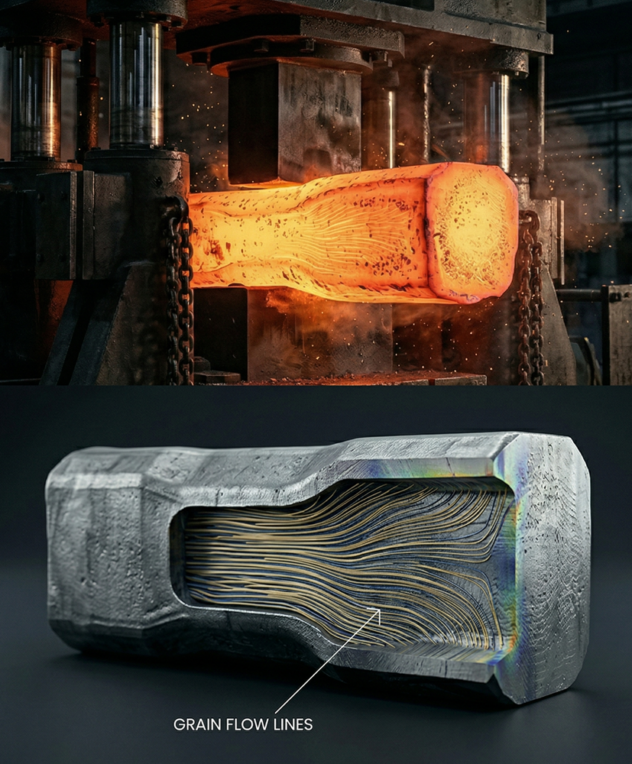
- Control deformation and grain flow
- Understand load paths and service conditions
Suppliers who “run what is specified” without engineering rationale are rarely approved for critical parts.
2. Traceability Built for Long Programs
Defence programs often require:
- Heat-level traceability
- Lot-wise segregation
- Record retention for 15–30 years
Buyers test whether suppliers can reconstruct part history long after delivery, not just at shipment.
3. Stability Under Low-Volume, Irregular Demand
Defence forging rarely follows predictable schedules.
Qualification evaluates whether suppliers can:
- Maintain quality across small batches
- Avoid process drift during long gaps
- Preserve knowledge despite personnel changes
High-volume-optimized systems often fail this test.
4. Special Process Governance
Heat treatment and NDT are treated as approval gates.
Defence buyers assess:
- Validation discipline
- Operator certification continuity
- Subcontractor control
- Sensitivity of inspection methods
Any weakness here delays or blocks qualification.
5. Audit Behavior Over Time
Defence qualification includes:
- Initial audits
- Follow-up audits
- Surveillance audits
- Program-specific reviews
Buyers observe patterns:
- Are NCRs recurring?
- Are root causes systemic?
- Does behavior improve over time?
Trust is built gradually, and lost quickly.
Why Defence Qualification Often Takes Years
The timeline is long because buyers deliberately:
- Observe suppliers across multiple cycles
- Introduce trial orders
- Stress-test systems during change
- Verify corrective actions over time
Speed is not the goal, confidence is.
Common Reasons Defence Suppliers Fail Qualification
Capable forging suppliers often fail due to:
- Overreliance on individual expertise
- Incomplete documentation discipline
- Weak deviation control
- Inconsistent traceability
- Treating defence like aerospace or oil & gas
Defence buyers expect a distinct operating model.
Why Automotive or Commercial Logic Breaks Down
Defence buyers avoid suppliers who:
- Optimize aggressively for cost
- Reduce inspection based on statistics
- Depend on repetition for quality
Defence programs value conservatism over efficiency.
How Defence Buyers Assess Long-Term Supplier Reliability
Buyers evaluate:
- Audit history and trendlines
- Response to non-conformances
- Transparency during issues
- Willingness to stop production
- Cultural alignment with defence risk posture
These signals matter more than technical claims.
How Vinir Aligns with Defence Qualification Expectations
Vinir is structured for defence programs through:
- Engineering-led forging process design
- High-mix, low-volume stability
- Integrated forge-to-finish accountability
- Heat-level traceability and record retention
- Validated special processes
- Continuous audit readiness
This allows Vinir to support defence programs where qualification is earned over time, and preserved deliberately.
FAQ
Why does defence qualification take longer than aerospace?
Because defence programs emphasize long-term reliability and strategic risk containment.
Can high-capacity suppliers qualify faster?
No. Capacity does not accelerate trust.
Are deviations ever allowed in defence forging?
Only through formal, approved concession processes.
Can suppliers lose defence approval?
Yes. Repeated NCRs or behavioral issues can result in suspension.