
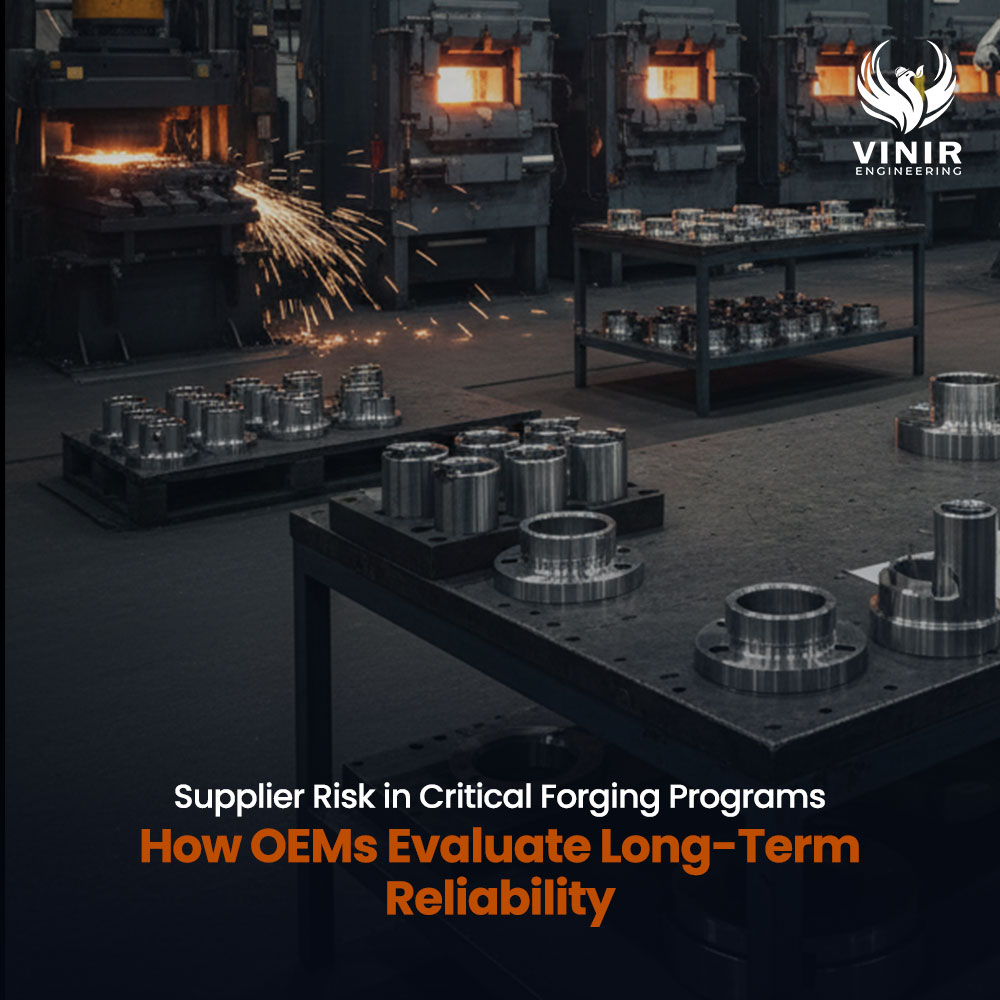
Supplier risk in critical forging programs: how oems evaluate long-term reliability
Why Supplier Risk Is a Board-Level Concern in Critical Programs
In critical industries, supplier failure is not an operational inconvenience, it is a program-level risk.
OEMs understand that:
- Components may be irreplaceable once deployed
- Programs often span decades
- Requalification is expensive and slow
- Failures carry safety, regulatory, and reputational consequences
As a result, OEMs evaluate forging suppliers through a long-term reliability lens, not short-term performance metrics.
How OEMs Define “Supplier Risk” in Forging Programs
Supplier risk is not limited to financial health or delivery timelines.
OEMs assess risk across multiple dimensions:
- Technical reliability
- System resilience
- Compliance sustainability
- Organizational continuity
- Audit performance history
A supplier can deliver perfect parts today and still be considered high risk for future programs.
1. Process Stability Over Time Not Just Capability Today
OEMs prioritize suppliers whose processes remain stable despite:
- Volume fluctuations
- Engineering changes
- Personnel turnover
- Long gaps between production runs
They look for:
- Documented forging routes
- Controlled parameters
- Evidence of repeatability across years, not batches
Suppliers whose quality depends on individual experience rather than systems are flagged as risky.
2. Traceability as a Long-Term Control System
Traceability is evaluated not as paperwork, but as a risk containment mechanism.
OEMs assess whether suppliers can:
- Maintain heat-level traceability indefinitely
- Preserve records for 15–30 years
- Reconstruct material history long after delivery
Suppliers who treat traceability as an administrative task fail long-horizon risk assessments.
3. Special Processes as Hidden Risk Multipliers
Heat treatment and NDT are often the highest-risk stages in forging supply chains.
OEMs evaluate:
- Validation discipline
- Calibration and survey rigor
- Operator certification continuity
- Subcontractor control
A supplier with strong forging but weak special process governance is considered structurally risky.
4. Audit History and Behavioral Patterns
OEMs examine audit behavior, not just outcomes.
They review:
- Frequency and type of NCRs
- Root cause depth
- Corrective action effectiveness
- Recurrence patterns
Repeated “minor” issues often indicate deeper systemic instability than isolated major NCRs.
5. Response to Deviations and Failures
Failures are inevitable. Risk lies in how suppliers respond.
OEMs assess whether suppliers:
- Detect issues early
- Escalate transparently
- Contain risk decisively
- Implement preventive actions
Defensive behavior or blame-shifting increases perceived risk dramatically.
6. Organizational Continuity and Knowledge Retention
Long-term programs outlive teams.
OEMs evaluate:
- Dependency on key individuals
- Documentation depth vs tribal knowledge
- Training systems for low-volume work
- Succession planning for critical roles
Suppliers whose systems collapse when people leave are high-risk by default.
7. Dependency and Concentration Risk
OEMs also consider:
- Single-machine dependencies
- Single-subcontractor reliance
- Overconcentration of revenue in one sector
Diversification is not just financial, it is operational resilience.
How OEMs Score and Compare Suppliers
OEMs typically combine:
- Audit results
- Delivery and quality performance
- Engineering engagement quality
- Transparency during issues
- Long-term behavioral consistency
The goal is not to find a perfect supplier, but a predictably reliable one.
Why Cost Is a Secondary Risk Indicator
Low cost can mask:
- Thin process margins
- Reduced inspection
- Aggressive yield assumptions
- Underinvestment in systems
OEMs treat unusually low pricing in critical programs as a risk signal, not a benefit.
How Vinir Reduces Supplier Risk for OEM Programs
Vinir is structured to minimize long-term OEM risk by operating with:
- Engineering-led forging and process planning
- High-mix, low-volume stability
- Integrated forge-to-finish accountability
- Heat-level traceability and record retention
- Validated special processes
- Consistent audit performance
This allows OEMs to rely on Vinir not just for parts, but for program continuity.
FAQ
How do OEMs assess supplier risk before onboarding?
Through audits, trial orders, documentation reviews, and behavioral evaluation during early engagements.
Can a technically capable supplier still be high risk?
Yes. Weak systems and poor long-term discipline elevate risk regardless of capability.
Is supplier risk reassessed after qualification?
Continuously. Surveillance audits and performance reviews are standard.
Why is long-term reliability more important than capacity?
Because requalification mid-program is costly, slow, and disruptive.