
Marine forging manufacturers: structural reliability for offshore and maritime systems
Marine Forgings Operate in Environments Where Failure Is Not Easily Contained
Marine and offshore systems operate in conditions that are both mechanically demanding and environmentally aggressive. Unlike land-based installations, marine components are exposed to continuous vibration, saltwater corrosion, dynamic loading, and limited accessibility for maintenance.
Forged components used in propulsion systems, offshore rigs, subsea assemblies, and heavy marine equipment must therefore be engineered for durability over extended service cycles.
In maritime environments, failure is not simply expensive — it is operationally disruptive and often hazardous.
For this reason, marine forging manufacturers must demonstrate more than dimensional capability. They must prove structural reliability under cyclic and corrosive conditions.
Types of Forged Components Used in Marine and Offshore Applications
Marine systems depend on a wide range of forged components, each exposed to different stress profiles.
These may include:
- Propulsion shafts
- Couplings and hubs
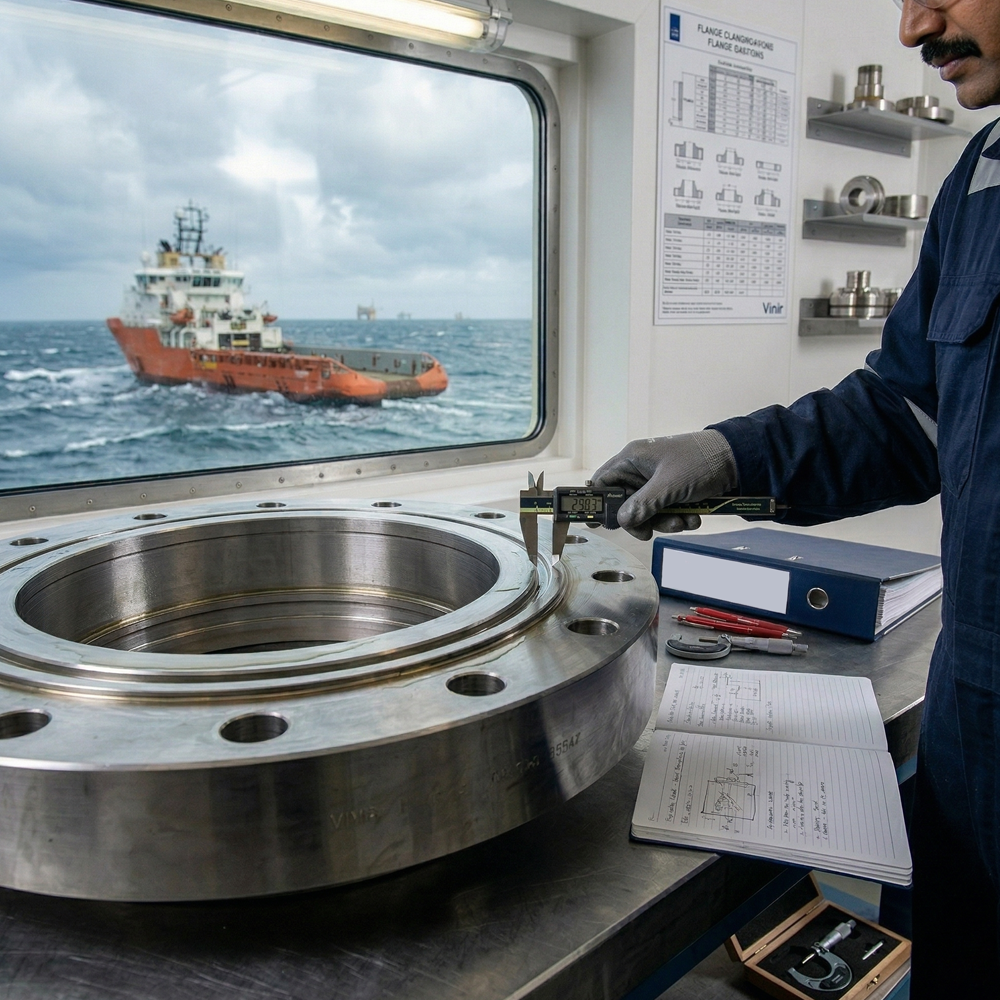
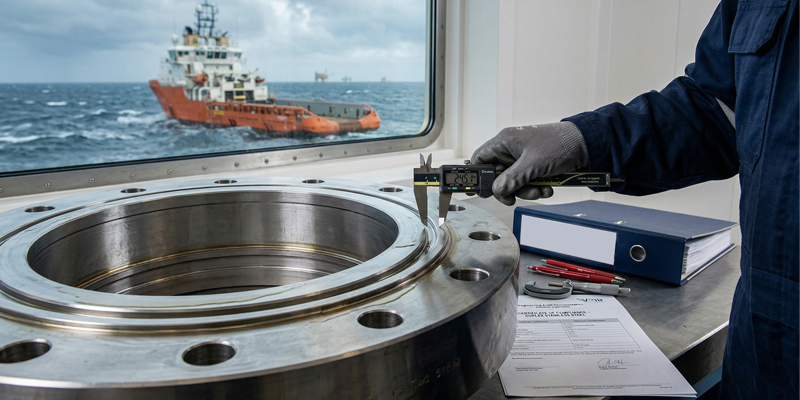
- Flanges for offshore piping systems
- Structural connectors
- Anchor system components
- Gyro system flywheel components
- Load-bearing deck hardware
Each component category brings different metallurgical and inspection expectations.
For example, propulsion shafts require fatigue resistance and grain alignment along the shaft axis, while flanges must maintain sealing integrity under pressure and vibration.
Understanding the service environment shapes forging process planning.
Corrosion Resistance and Material Selection in Marine Forgings
Saltwater exposure introduces a persistent corrosion risk that directly influences material selection and heat treatment strategy.
Marine forgings may require:
- Stainless steel grades
- Duplex or super duplex steels
- Alloy steels with protective treatments
- Material grades resistant to stress corrosion cracking
Material pedigree control is critical because corrosion-related failures often originate from subtle metallurgical inconsistencies.
Manufacturers must verify:
- Chemical composition accuracy
- Inclusion control
- Controlled heat treatment cycles
- Surface integrity
Improper material handling or incorrect hardness levels can accelerate corrosion fatigue.
Fatigue Performance Under Cyclic Loading
Marine propulsion and offshore mechanical systems operate under repetitive stress cycles.
Forged components in these environments experience:
- Rotational forces
- Torsional stress
- Vibration-induced fatigue
- Dynamic wave loading
Grain flow orientation becomes especially important in these cases.
When deformation planning aligns grain structure with principal stress directions, fatigue resistance improves significantly.
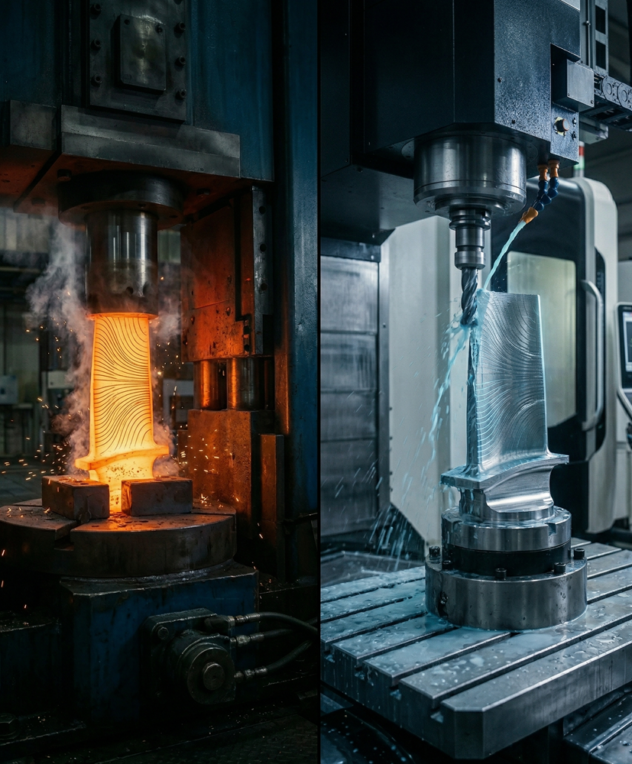
This is why reduction ratio discipline and forging process engineering are critical in marine forgings.
Fatigue resistance cannot be added later through machining — it must be built into the forging itself.
Classification Society Requirements and Inspection Expectations
Marine forgings often require approval from classification bodies such as:
- ABS (American Bureau of Shipping)
- DNV
- Lloyd’s Register
These organizations assess whether components meet structural and safety standards for maritime operation.
Approval may require:
- Material certification
- Mechanical property validation
- Ultrasonic testing
- Surface inspection
- Documented heat treatment records
Inspection expectations in marine applications are not merely procedural. They reflect structural safety requirements for vessels and offshore platforms.
Manufacturers must demonstrate both technical competence and documentation integrity.
Pressure and Structural Integrity in Offshore Applications
Offshore oil platforms and subsea installations introduce combined stress factors, including:
- Hydrostatic pressure
- Corrosion
- Thermal variation
- Dynamic mechanical forces
Forged components used in these environments must maintain structural soundness under multidimensional stress.
Adequate deformation during forging ensures:
- Elimination of internal voids
- Grain refinement
- Structural densification
Ultrasonic inspection acceptance rates often correlate directly with reduction ratio discipline.
Forging process planning therefore becomes a safety-critical activity.
Documentation and Traceability in Marine Supply Chains
Marine and offshore projects frequently involve international regulatory oversight.
Suppliers must maintain documentation that connects:
- Raw material heat numbers
- Forging batch records
- Heat treatment cycles
- NDT reports
- Dimensional inspection logs
Traceability continuity ensures that components can be verified long after installation.
In offshore environments where maintenance windows are limited, documentation clarity supports long-term operational integrity.
Lifecycle Expectations and Spare Part Continuity
Marine assets are built for extended service lifetimes.
Forging suppliers must demonstrate the ability to:
- Reproduce components years after initial delivery
- Maintain documentation archives
- Support retrofit or replacement programs
- Ensure consistency across production batches
Operational stability and long-term manufacturing continuity therefore influence supplier selection decisions.
Why High-Mix Capability Aligns with Marine Projects
Marine and offshore programs are often project-driven rather than volume-driven.
They involve:
- Custom geometries
- Moderate batch sizes
- Material variation
- Client-specific inspection plans
- International regulatory requirements
Forging manufacturers optimized exclusively for repetitive automotive production may struggle with this variability.
High-mix manufacturing capability, combined with strong documentation systems, aligns more effectively with marine sector requirements.
Marine Forging at Vinir Engineering
Vinir Engineering operates as a non-automotive, high-mix, forge-to-finish manufacturer structured to support marine and offshore applications.
Our manufacturing systems emphasize:
- Controlled grain flow engineering
- Documented reduction ratio validation
- Material traceability continuity
- Integrated heat treatment and machining coordination
- Certified inspection processes
- Audit-ready documentation architecture
Serving marine and offshore industries requires structural discipline, not throughput optimization.
If your project involves propulsion components, offshore structural forgings, pressure-rated flanges, or fatigue-critical marine systems, Vinir’s engineering team can review specifications and compliance expectations.
Connect with Vinir Engineering to discuss your marine forging requirements.