
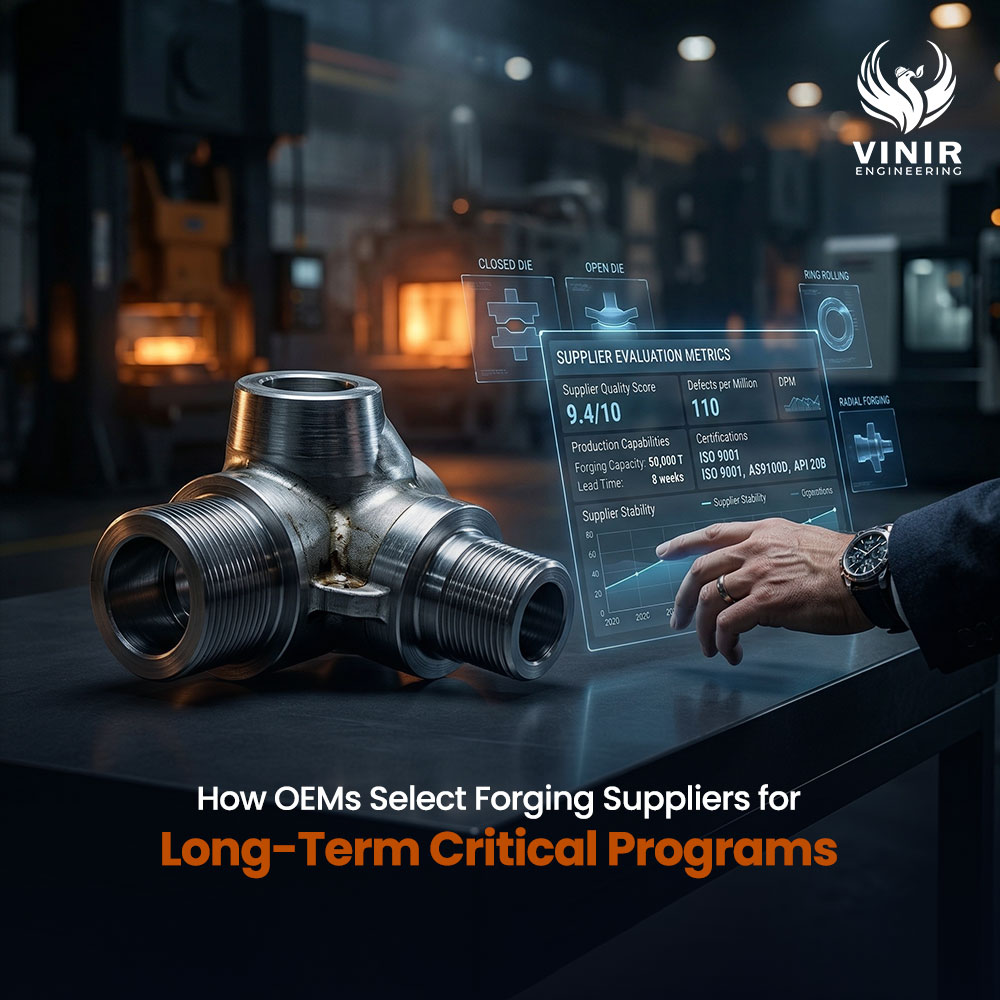
How oems select forging suppliers for long-term critical programs
Supplier Selection Is Risk Selection
In critical industries, selecting a forging supplier is not a transactional decision. It is a long-term risk allocation decision.
Oil & gas systems operate under pressure. Aerospace components operate under fatigue. Defence platforms operate under mission-critical conditions. Nuclear installations operate under regulatory scrutiny.
In these environments, a forging supplier is not simply a manufacturer — it is a structural partner.
OEMs evaluating forging manufacturers do not focus only on cost, capacity, or lead time. They evaluate systemic reliability, process maturity, and long-term operational stability.
Understanding how OEMs select forging suppliers reveals what truly differentiates qualified manufacturers from commodity producers.
1. Technical Capability Beyond Equipment Lists
Most forging companies present:
- Press tonnage
- Maximum forging size
- Machining centers
- Heat treatment capacity
However, OEM technical teams evaluate deeper parameters:
- Reduction ratio control capability
- Grain flow engineering approach
- Heat treatment validation systems
- Inspection infrastructure
- NDT certification levels
- Tolerance consistency history
Equipment capacity alone does not indicate metallurgical competence.
In critical programs, OEMs often request technical discussions before commercial negotiations begin.
2. Industry-Specific Experience and Qualification History
Forging for automotive components differs fundamentally from forging for:
- Pressure-retaining oil & gas components
- Aerospace rotating assemblies
- Defence mobility systems
- Nuclear regulatory applications
OEMs review:
- Prior industry approvals
- Certification scope alignment
- Historical audit performance
- Long-term customer relationships
- Program retention rates
Non-automotive forging requires process flexibility and documentation depth that high-volume automotive systems may not prioritize.
Industry-specific maturity reduces onboarding risk.
3. Compliance Architecture and Audit Readiness
Before awarding contracts, OEMs often conduct:
- On-site audits
- Process walkthroughs
- Documentation reviews
- Quality system verification
Auditors evaluate:
- Traceability systems
- Non-conformance management
- Corrective action procedures
- Risk management practices
- Supplier training records
Compliance architecture must demonstrate repeatability, not isolated performance.
A supplier that passes one audit but lacks systemic discipline creates long-term exposure risk.
4. Financial and Operational Stability
Critical programs may span:
- 5 to 20 years
- Multi-phase engineering updates
- Lifecycle maintenance requirements
OEMs therefore evaluate:
- Financial sustainability
- Ownership stability
- Capacity planning strategy
- Capital investment history
- Workforce retention
A technically strong supplier without operational stability may introduce program risk.
Supplier continuity matters as much as component quality.
5. High-Mix Manufacturing Adaptability
In non-automotive sectors, order patterns are rarely high-volume and repetitive.
Programs may require:
- Multiple material grades
- Custom geometries
- Variable batch sizes
- Tight documentation cycles
OEMs assess whether a forging manufacturer can:
- Adapt process parameters
- Handle frequent changeover
- Maintain documentation consistency
- Scale without compromising quality
High-mix, low-volume capability often differentiates specialized industrial manufacturers from automotive-optimized suppliers.
6. Engineering Collaboration Capability
In early program stages, OEM engineering teams may require:
- Design-for-forging input
- Grain flow recommendations
- Machining allowance strategy
- Heat treatment advice
- Inspection planning coordination
Suppliers that provide engineering feedback reduce:
- Design iteration cycles
- Qualification delays
- Production rework
OEMs increasingly favor forging partners capable of technical collaboration rather than passive execution.
7. Risk Management and Contingency Planning
Critical industries require risk visibility.
OEMs evaluate:
- Backup equipment availability
- Redundancy planning
- Preventive maintenance systems
- Raw material sourcing diversification
- Crisis response protocols
A supplier’s ability to manage disruptions influences long-term partnership viability.
8. Cost Structure Transparency
While price is not the primary driver in critical applications, cost transparency matters.
OEMs examine:
- Material sourcing structure
- Tooling amortization models
- Heat treatment cost components
- Inspection cost drivers
- Machining allowances
Suppliers capable of explaining cost drivers technically inspire greater confidence than those competing purely on price.
9. Long-Term Performance Track Record
Past performance remains one of the strongest evaluation criteria.
OEMs may review:
- Historical rejection rates
- NCR trends
- On-time delivery records
- Corrective action turnaround times
- Field performance feedback
Long-term consistency outweighs short-term cost advantages.
10. Why Non-Automotive Forging Requires Specialized Evaluation
Automotive forging systems prioritize:
- Cycle time efficiency
- Cost per unit optimization
- Statistical repetition
Critical industrial forging prioritizes:
- Structural reliability
- Qualification endurance
- Compliance continuity
- Engineering responsiveness
OEMs understand that selecting a supplier optimized for the wrong production philosophy introduces structural misalignment.
Conclusion
OEMs selecting forging suppliers for long-term critical programs evaluate far more than production capability.
They assess:
- Metallurgical control maturity
- Compliance depth
- Industry-specific experience
- Operational stability
- Engineering collaboration strength
- Risk management architecture
Supplier selection becomes a decision about reliability, traceability, and long-term partnership alignment.
In critical industries, forging is not procurement. It is program infrastructure.
Why OEMs Partner with Vinir Engineering
Vinir Engineering operates as a fully non-automotive, high-mix, forge-to-finish manufacturer structured specifically for critical industrial sectors.
Our approach aligns with OEM evaluation priorities:
- Controlled metallurgical processes
- Integrated forging and machining
- Certification-aligned compliance systems
- Audit-ready documentation
- Engineering collaboration capability
- Long-term program support
Serving oil & gas, aerospace, defence, nuclear, marine, railway, and heavy equipment industries requires structured discipline beyond capacity metrics.
If you are qualifying forging suppliers for a new or ongoing program, Vinir’s engineering team can support technical discussions, compliance alignment, and long-term supply evaluation.
Connect with Vinir Engineering to discuss your critical forging requirements.