
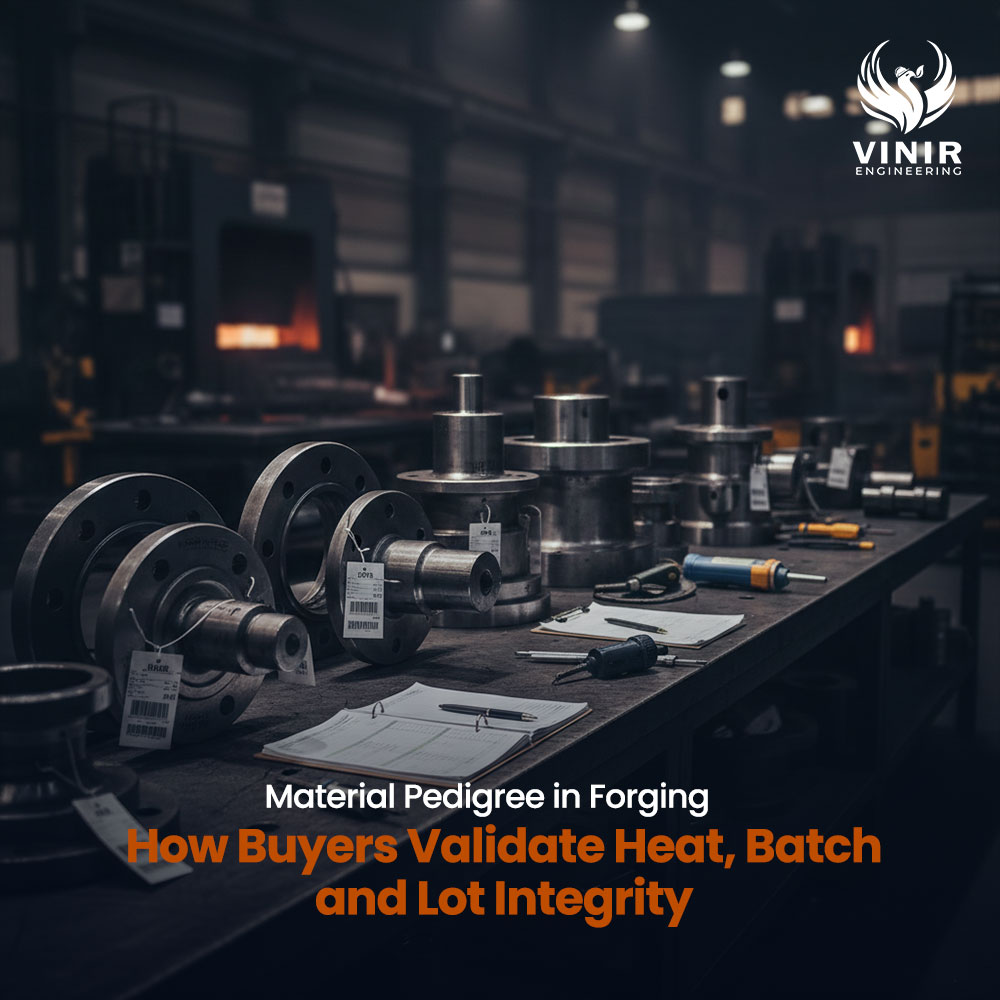
Material pedigree in forging: how buyers validate heat, batch, and lot integrity
Why Material Pedigree Is Treated as a Risk Issue
In critical industries, material failure is rarely caused by design alone.
It is more often traced to:
- Mixed heat materials
- Incomplete mill certificates
- Traceability breaks during forging or machining
- Incorrect heat treatment application
For buyers, pedigree is not documentation — it is risk containment.
What Buyers Mean by “Material Pedigree”
Material pedigree means the supplier can demonstrate:
- Exact origin of raw material (mill, heat number, grade)
- Controlled movement of material through forging, heat treatment, machining, and inspection
- Verifiable linkage between physical parts and records
If any link cannot be proven, the pedigree is considered broken.
How Buyers Validate Heat-Level Traceability
Auditors physically and digitally cross-check:
- Heat numbers stamped or tagged on material
- MTCs mapped to forging batches
- Batch cards and travelers
- Machining lot records
- Inspection and test reports
Even one undocumented transfer can trigger a major non-conformance.
Batch and Lot Segregation: A Common Failure Point
Many suppliers fail not during forging — but during handling.
Buyers check:
- Physical segregation of different heats
- Color coding or tagging systems
- Controlled storage and WIP movement
- Procedures for partial batch processing
Mix-ups at this stage are treated as systemic quality failures.
Pedigree Across Heat Treatment and Special Processes
Special processes intensify pedigree scrutiny.
Auditors verify:
- Furnace load composition
- Heat treatment cycle linkage to specific heats
- NDT reports tied to individual batches
If furnace loads combine multiple heats without control, pedigree risk increases sharply.
Long Lifecycle Programs Demand Pedigree Retention
Defence, aerospace, and nuclear programs may require:
- Record retention for 15–30 years
- Reproducibility after long dormancy
- Historical traceability for in-service investigations
Suppliers must preserve pedigree long after delivery.
Why Pedigree Fails Even in Capable Forging Facilities
Common breakdowns include:
- Manual data transfer between systems
- Outsourced machining without documentation continuity
- Weak ERP–shop-floor integration
- Overreliance on individual operators
These failures are operational, not technical.
How Vinir Maintains Material Pedigree End-to-End
Vinir structures its forging operations to preserve pedigree by:
- Heat-level material control
- Integrated forge-to-finish workflows
- Controlled batch and lot segregation
- Linked inspection and certification records
- Audit-ready documentation systems
This ensures traceability is preserved — not reconstructed later.
FAQ
What happens if material pedigree is lost?
The component is typically rejected, regardless of dimensional or mechanical compliance.
Is heat stamping mandatory?
For critical applications, physical heat identification or equivalent traceable tagging is expected.
Can pedigree be restored retroactively?
Rarely. Buyers generally do not accept reconstructed traceability.Do all industries require this level of pedigree?
No. This level is typical for defence, aerospace, oil & gas, nuclear, and rail programs.