
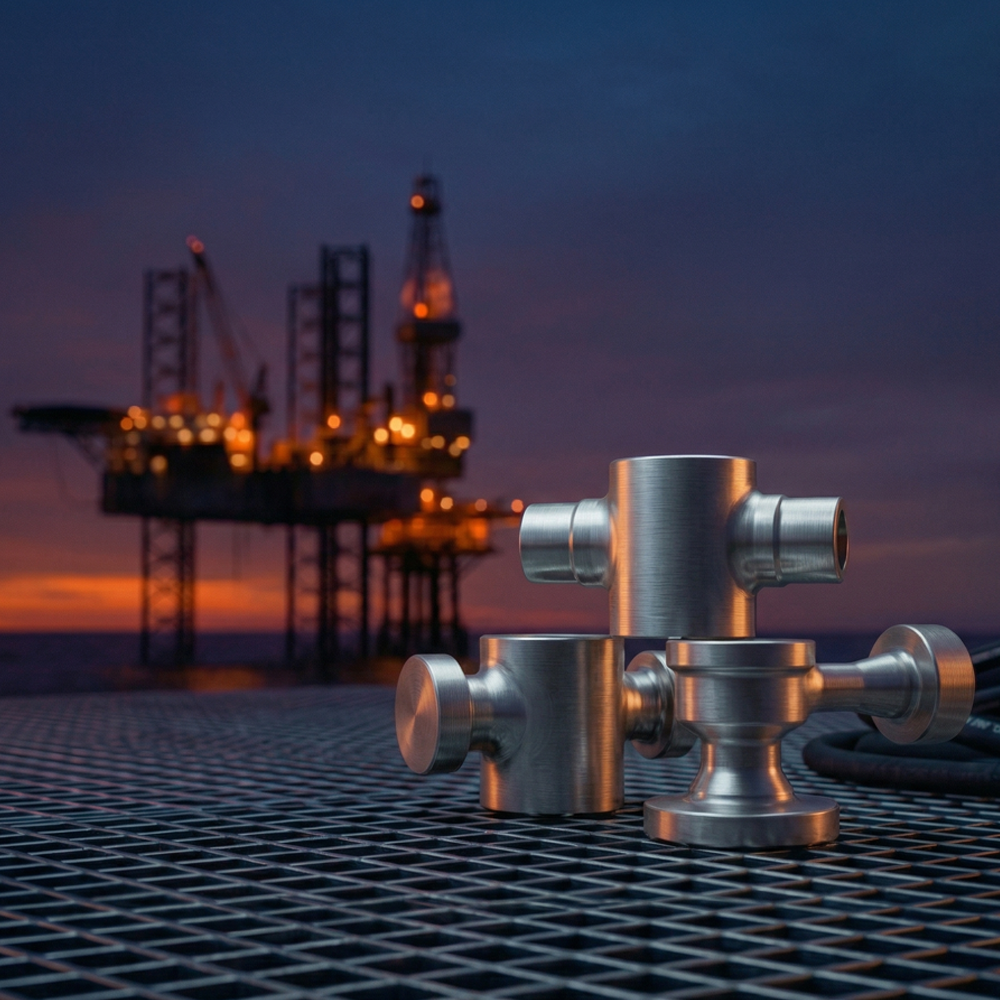
Duplex & super duplex forgings for offshore and oil & gas applications
Why Duplex Steels Are Critical in Offshore Environments
Offshore oil & gas systems operate in one of the most aggressive industrial environments: high chloride exposure, pressure variation, cyclic mechanical loading, and elevated temperatures.
Standard carbon steels corrode. Conventional stainless steels may suffer from pitting or stress corrosion cracking. In such environments, duplex and super duplex stainless steels are often specified for forged components.
Duplex steels combine:
- Austenitic structure (corrosion resistance)
- Ferritic structure (strength and stress corrosion resistance)
This dual-phase microstructure gives duplex forgings a unique balance of:
- High mechanical strength
- Excellent resistance to chloride-induced pitting
- Superior stress corrosion cracking resistance
- Improved fatigue performance compared to standard austenitic stainless steels
In offshore oil & gas systems, material selection is not optional — it is survival engineering.
Where Duplex Forgings Are Used in Oil & Gas
Duplex and super duplex forged components are commonly used in:
- Subsea connectors
- Valve bodies and bonnets
- Pump shafts
- Flanges
- Pressure-retaining housings
- Offshore structural components
These components face:
- High hydrostatic pressure
- Seawater exposure
- Cyclic pressure loads
- Temperature fluctuations
Forging provides structural density and grain flow alignment, which are critical for maintaining mechanical integrity under these conditions.
Mechanical Advantages of Duplex Forgings
Compared to conventional 300-series stainless steels, duplex grades offer:
- Nearly double the yield strength
- Higher tensile strength
- Better resistance to stress corrosion cracking
- Improved fatigue resistance
This allows designers to:
- Reduce wall thickness in pressure systems
- Maintain structural safety margins
- Improve weight efficiency in offshore assemblies
However, these advantages are only realized if forging and heat treatment are properly controlled.
Microstructure Control: The Core Challenge in Duplex Forging
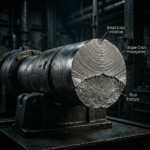
The performance of duplex steel depends heavily on maintaining the correct ferrite–austenite balance, typically close to 50/50.
Improper forging temperature or heat treatment can lead to:
- Excess ferrite formation
- Intermetallic phase precipitation
- Reduced toughness
- Loss of corrosion resistance
During forging, temperature control must prevent:
- Sigma phase formation
- Excessive grain growth
- Phase imbalance
Cooling rates after forging are particularly critical. Too slow, and harmful intermetallic phases may form. Too fast, and thermal stress may increase.
Duplex forging is not simply shaping stainless steel — it is controlled microstructure engineering.
Super Duplex: Higher Strength, Higher Sensitivity
Super duplex steels provide even greater corrosion resistance and strength than standard duplex grades.
They are often used in:
- Deepwater subsea systems
- High-chloride offshore zones
- High-pressure connectors
However, super duplex grades are more sensitive to:
- Heat treatment deviations
- Improper forging temperature windows
- Surface contamination
- Inclusion presence
The margin for process error narrows significantly.
Forging manufacturers serving offshore sectors must demonstrate thermal and metallurgical discipline specific to duplex materials.
Heat Treatment Requirements for Duplex Forgings
Solution annealing is typically required to restore balanced microstructure after forging.
This involves:
- Controlled high-temperature soaking
- Rapid quenching
- Hardness verification
- Microstructure confirmation where necessary
Heat treatment must eliminate harmful precipitates while maintaining phase balance.
Improper solution treatment can compromise corrosion resistance even if mechanical strength appears acceptable.
Inspection and Testing in Offshore Duplex Forgings
Because duplex forgings are often used in pressure and subsea systems, inspection expectations are rigorous.
Testing may include:
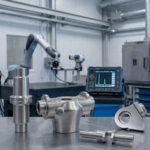
- Ultrasonic testing
- Hardness testing
- Ferrite content measurement
- Corrosion testing (where specified)
- Impact testing
Material certification must confirm chemical composition within specified PREN (Pitting Resistance Equivalent Number) ranges.
In offshore systems, corrosion failure is as critical as mechanical fracture.
Common Risks in Duplex Forgings
Failures in duplex forged components often trace back to:
- Improper thermal control
- Inadequate solution annealing
- Inclusion contamination
- Surface scaling
- Weld heat-affected zone issues
Because duplex steels are sensitive to phase imbalance, process control must be continuous — not reactive.
Offshore buyers frequently audit forging suppliers specifically for duplex heat treatment discipline.
Duplex Forgings at Vinir Engineering
Vinir Engineering manufactures duplex and super duplex forged components for offshore and oil & gas applications within a controlled, non-automotive forging framework.
Our systems emphasize:
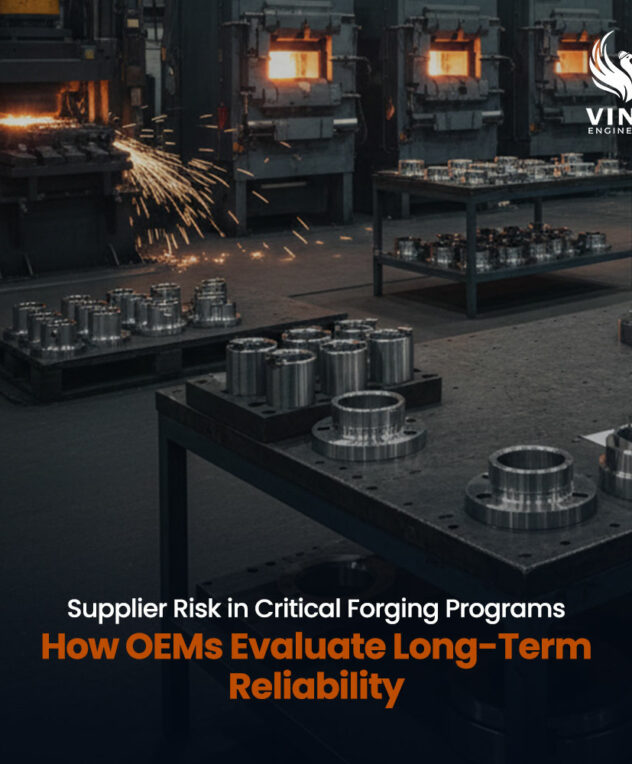
- Controlled forging temperature windows
- Documented reduction ratio validation
- Phase balance awareness during heat treatment
- Integrated machining coordination
- Continuous material traceability
- Audit-ready documentation systems
Serving offshore sectors requires metallurgical discipline aligned with corrosion and fatigue demands.
If your project involves duplex or super duplex forged components for subsea, pressure-retaining, or offshore structural systems, Vinir’s engineering team can review material specifications and compliance expectations.
Connect with Vinir Engineering to discuss duplex forging requirements for offshore and oil & gas applications.